Some of the CDs on my shelf are older than many of today’s streaming services.
I started collecting music in the 1990s. At the time, discovering an album usually meant hearing about it from a friend, reading a review, or finding it in a record store. Bringing a CD home felt like the beginning of something. I would open the case, read the booklet, look through the credits, and listen from the first track to the last.
The album had a physical place in the room and a place in my memory. It was not simply available. It was mine.
One of my first Telarc CDs was Round-Up. I did not yet have the vocabulary to explain why it sounded different. I only knew that it did. The dynamics were larger, the space around the instruments felt more real, and the recording itself became part of the experience. That disc made me pay attention not only to the music, but also to how music was recorded and played back.
The collection grew one album at a time. Some purchases were carefully planned. Others happened because a cover caught my eye or because I was curious about a performer I had never heard before. A few became favorites immediately. Others waited on the shelf until the right day.
A collection becomes a personal history
After enough years, a music collection stops being a list of albums.
Some discs remind me of where I was living when I bought them. Some bring back a long drive, a particular room, or a period of life. Some were difficult to find. Some were gifts. Some are not objectively rare or valuable, but I would notice immediately if they disappeared.
That is the part of collecting that a catalog cannot reproduce. A catalog tells you what is available. A collection tells you what you chose.
My shelves gradually became a record of those choices. Classical recordings sat beside film scores, jazz, rock, and albums that never fit neatly into one category. I did not collect according to a plan. I kept the music I wanted to hear again.
As computers became a more important part of listening, I began ripping CDs. The files were easier to access, but the work introduced a new kind of care. Album titles needed to be consistent. Artwork needed to be correct. Box sets, multi-disc releases, and different editions needed to make sense when the physical packaging was no longer in front of me.
The collection was becoming digital, but it was not becoming less personal.
Digitizing vinyl was slow for a reason
I also digitized records from vinyl.
There was nothing efficient about it. A record had to be cleaned, played in real time, recorded carefully, divided into tracks, named, checked, and archived. If something went wrong near the end of a side, there was no shortcut around doing it again.
But the slowness was part of the point. I was not trying to create the fastest possible path to a song. I was preserving a recording I cared about.
Those files carried more than sound. They carried the time spent making them: choosing the playback level, listening for problems, finding the right artwork, and deciding how the finished album should live beside the rest of the library.
That experience changed how I thought about digital music. A file may be easy to copy, but it can still represent years of listening, searching, and work.
Streaming changed discovery, not ownership
Streaming changed almost everything about how music is discovered. I use it and appreciate it. It makes exploration effortless. A recommendation can lead to an unfamiliar artist in seconds, and an album that once required a long search may now be immediately available.
But streaming never replaced my own library.
Some recordings were missing. Some appeared only in a different edition or mastering. Some disappeared after licensing changes. Others were present, but without the artwork, sequence, or metadata I remembered. The catalog could be enormous and still not contain the exact version that mattered to me.
Streaming is someone else’s catalog. A collection is your own history.
The two can live together. Streaming is often where I discover music. My collection is where the music stays after I decide it matters.
The library moved, but it never disappeared
The physical collection followed me through moves and changing listening rooms. The digital library followed a similar path: from one computer to another, from internal storage to external drives, and later to network storage.
Hardware changed quickly. The library did not.
Every move made the same problem more obvious. The files were increasingly organized and valuable to me, but the software around them rarely felt permanent. Some players were technically powerful but visually dated. Some looked polished but treated local files as a secondary feature. Some handled every format imaginable but never felt natural on macOS.
I wanted a player that respected both sides of the experience.
It should handle a serious local library without making the library feel like a database. Albums should still feel like albums. Artwork should be large enough to enjoy. Search and browsing should remain fast as the collection grows. A queue should be understandable. The technical path should be visible when I want to inspect it and quiet when I simply want to listen.
MPD was part of the path
I spent time experimenting with MPD and different playback setups. MPD was reliable and flexible, and it taught me a great deal about libraries, queues, remote control, and the separation between playback and interface.
It also made one question difficult to ignore: what would this feel like as a complete Mac app?
I was not trying to start a software company. I was trying to improve the system I used at home.
I wanted the reliability of a dedicated playback engine, but I also wanted the experience to belong on macOS. I wanted familiar interaction, careful typography, responsive browsing, and an interface that did not make listening feel like system administration.
The work continued on and off for nearly two years. It was not a straight line. Some ideas worked and stayed. Others became too complicated and were removed. The project changed as I used it with a real library rather than a small test folder.
The features came from the collection
Support for FLAC, ALAC, APE, WavPack, CUE sheets, DSD, and SACD ISO did not begin as a checklist. Those formats were already part of the music I wanted to play.
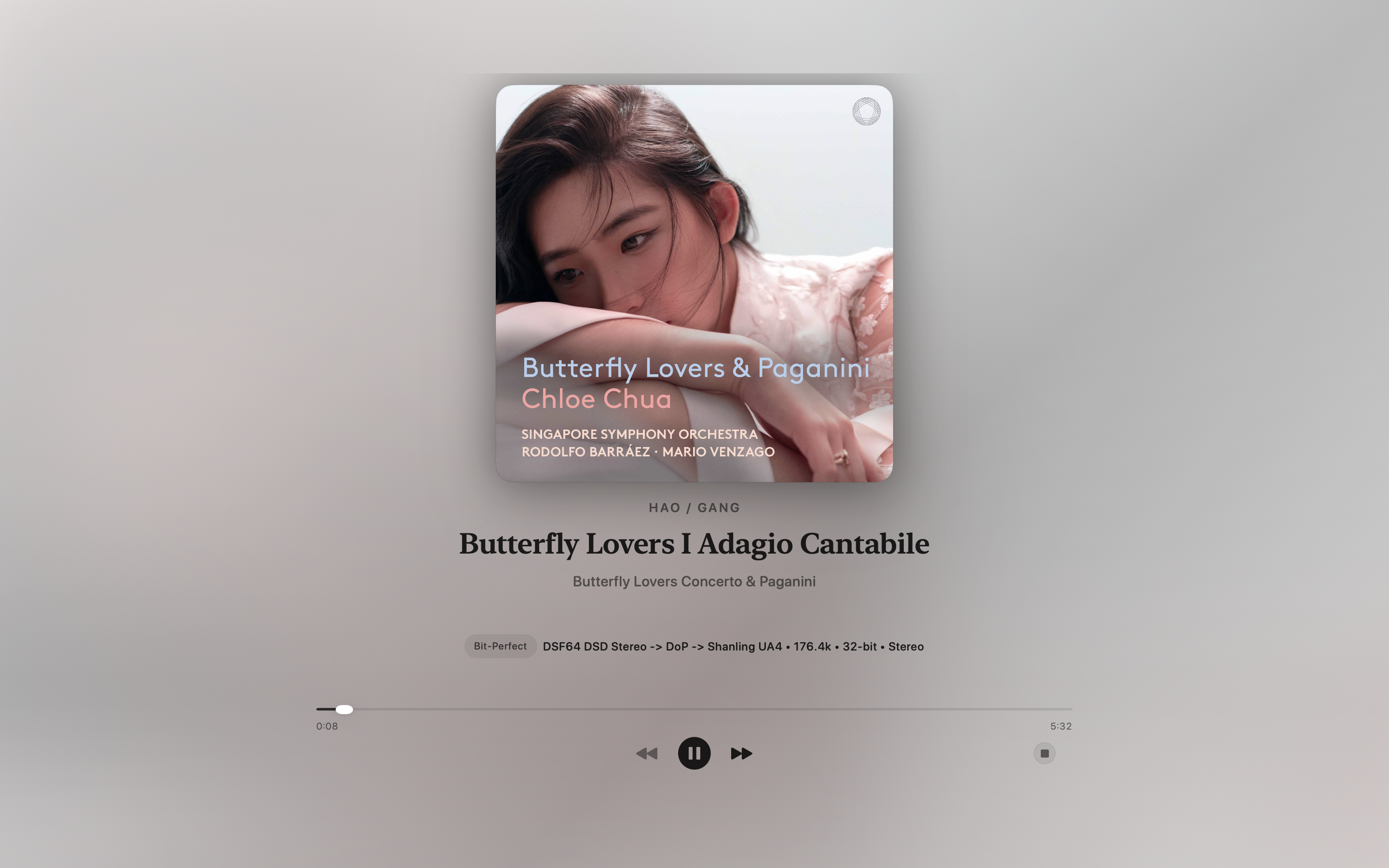
Gapless playback mattered because albums are not always a group of isolated tracks. Sample-rate matching mattered because I wanted the output to follow the source. A transparent audio path mattered because I wanted to know what the software was doing without guessing.
The same was true of smaller details. Remembering where I was. Preloading the queue. Keeping artwork readable. Making a large library scroll smoothly. Showing enough technical information to be useful without allowing it to dominate the screen.
Each decision came back to the same goal: make it easier to return to the music.
Somewhere in that process, the experiment became the player I wanted to use every day.
That player became Audio Lounge.
A home, not a replacement
Audio Lounge is not intended to replace streaming. I still use streaming services, and I expect most listeners will continue to use them.
It exists for a different part of listening.
It is for the albums you chose to keep. The versions you care about. The recordings you digitized. The files you have moved across computers, drives, and years. It is for a collection that reflects your own listening history rather than the current state of a service’s catalog.
I do not think everyone needs to maintain a local music library. But for the people who do, that library deserves software built around it rather than added as an afterthought.
Streaming is where I discover music.
Audio Lounge is where I come home to it.
After more than thirty years of collecting, I still believe a personal music library is more than a folder full of files.
And I think it deserves a better home.