I started collecting music back in the 1990s.
Back then, discovering an album usually meant bringing home a CD. Sometimes I knew exactly what I wanted. Sometimes I bought something because of a review, a recommendation, or simply because the cover caught my eye. Either way, the moment did not end at the cash register.
I would open the case, read the booklet, look through the credits, and listen from the first track to the last. A new album felt complete. It had a beginning, an ending, and a physical place on the shelf. It was not just something to hear. It was something to keep.
My collection grew slowly. A few discs became a few shelves. The shelves followed me through moves, new computers, and new ways of listening. Some albums were easy to find. Others were specific editions, unusual recordings, or releases that later went out of print.
Years later, I began ripping CDs and organizing the files on my computer. That made the collection easier to carry, but it also made me more aware of the details. Which mastering was this? Was the artwork correct? Why was the artist name written three different ways? The more the collection grew, the more those small things mattered.
Streaming changed how I discovered music
Streaming is convenient. I still use it. It is often the fastest way to hear a new release or follow a recommendation without thinking about storage, file formats, or metadata.
But streaming never fully replaced the collection I had already built.
Some recordings were missing. Some appeared only in a different edition. Some albums disappeared after licensing changes. Others were available, but not in the version I remembered. A catalog can be enormous and still not contain the exact recording, mastering, artwork, or sequence that matters to a particular listener.
There were also records I digitized myself. Transferring vinyl was never especially fast, and I did not do it because it was efficient. I did it because the record was worth keeping and because I wanted to hear it without taking it off the shelf every time.
Those files carried more than audio. They carried the work that went into making them—the cleaning, the recording, the track boundaries, the artwork, and the small decisions that turned a physical record into part of a digital library.
Streaming made discovery easier. It did not make ownership less meaningful.
The collection stayed
I like knowing which version of an album I have. I like keeping the artwork I remember. I like correcting a title, a date, or an artist name when the metadata is wrong. None of this is particularly glamorous. It is simply part of living with a collection for a long time.
The files moved from one drive to another. At different points they lived on a Mac, an external disk, and network storage. Hardware failed, storage became cheaper, and computers changed. The collection remained.
What kept bothering me was the software around it.
Many music players were powerful but felt dated. Others looked polished but treated local files as an afterthought. Some made playback the center of everything and browsing feel secondary. Others handled a library well but hid too much of the audio path.
I wanted something more balanced. Albums should look like albums, not database entries. Search should be fast. A queue should be easy to understand. Technical details should be available without turning every listening session into a setup exercise.
Then I started experimenting with MPD
I did not set out to build a product. I was trying to improve my own listening setup.
MPD gave me a reliable playback engine and a useful way to think about libraries, queues, formats, and remote control. I spent a lot of time experimenting with it. Some of that work solved practical problems. Some of it was simply curiosity.
The more I used it, the more I kept coming back to the same question: what would this feel like as a real Mac app?
I wanted the reliability and control of a serious playback system, but I also wanted something that felt natural on macOS. I wanted the interface to be calm. I wanted artwork to matter. I wanted the app to make a large collection feel inviting instead of heavy.
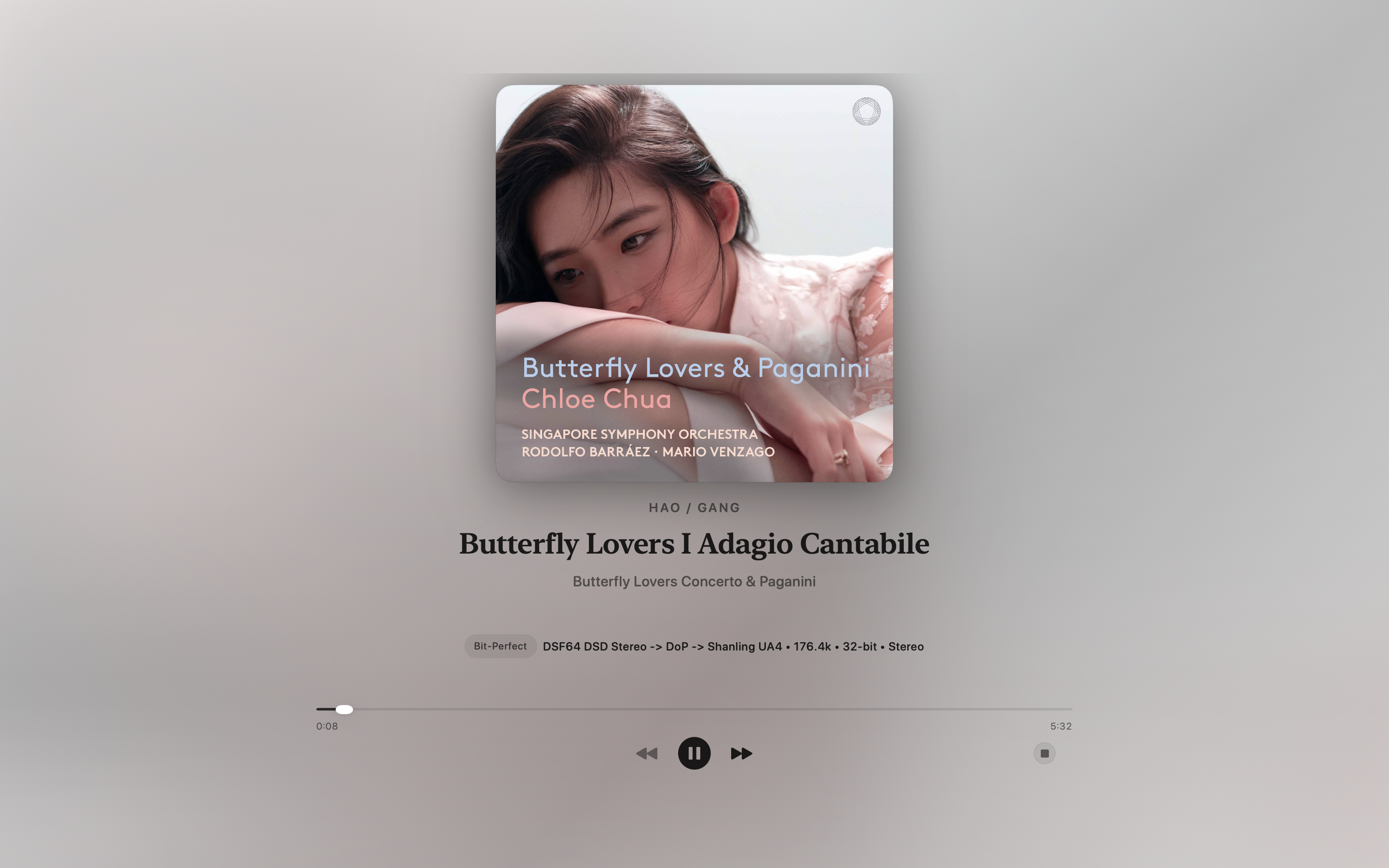
I also wanted transparency without clutter. If a file was being decoded, converted, upsampled, or sent through a particular output path, I wanted to be able to see that. But when I was simply listening, I wanted those details to stay out of the way.
I worked on that idea on and off for nearly two years.
The project became more personal
The first goal was simple: make local playback feel better on my Mac. Then the library view improved. The queue became more flexible. Gapless playback mattered. Sample-rate matching mattered. DSD and SACD ISO mattered because they were already part of the collection.
Each addition came from something I wanted to use, not from a feature checklist.
The same was true of the smaller details. Remembering where I was. Making artwork readable. Keeping the interface responsive with a larger library. Showing the source format and final output clearly. None of those things alone defines a music player, but together they decide whether I enjoy opening it every day.
Somewhere in that process, the project stopped feeling like an experiment and started feeling like its own place.
That place became Audio Lounge.
Not a replacement for streaming
I still use streaming services. They are excellent for discovery and for listening to music I do not own. Audio Lounge is for a different part of the experience.
It is for the albums you chose to keep. The versions you care about. The recordings you digitized. The files you have carried across computers and years. The collection that reflects your own listening history rather than a service's current catalog.
I do not think everyone needs a local music library. But for the people who have one, it deserves to feel intentional.
Music collections deserve software that treats them as more than a folder full of files.
They deserve a better home.